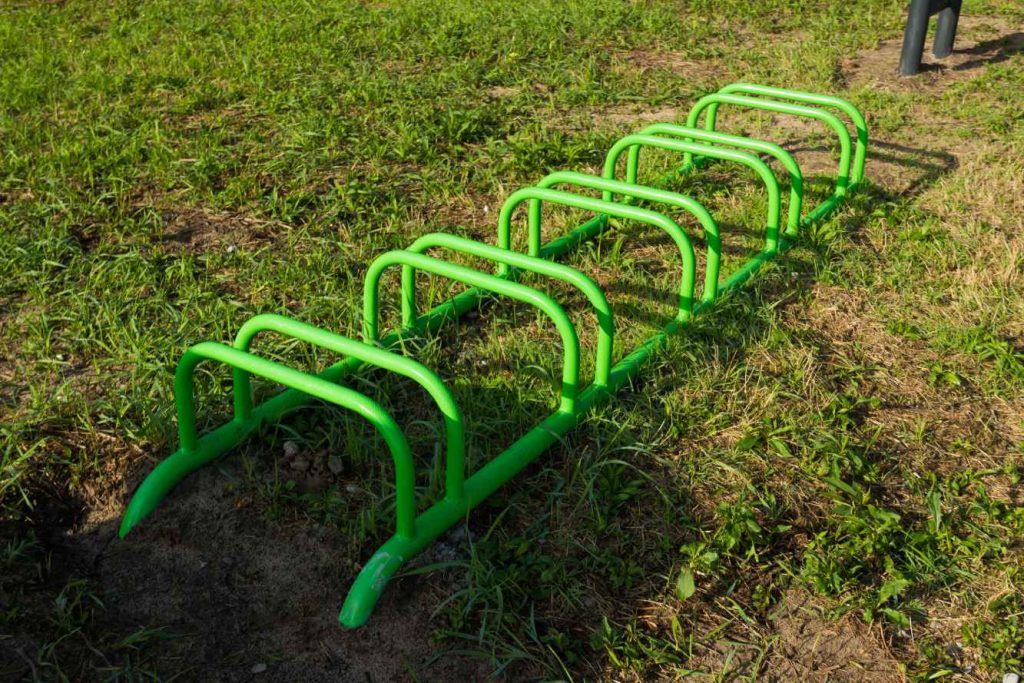
September is a good time to talk about how children, teenagers and adults get to school, work and places of recreation. European Mobility Week takes place every year from 16 to 22 September, and its aim is to promote walking, cycling and public transport, among other things. In 2026, the campaign ran under the slogan “Mobility for Everyone”, with a particular focus on the needs of different generations. Encouraging students to cycle to school only makes sense, however, if they actually have somewhere safe to leave their bike once they arrive. A bike rack deserves the same attention as a bench, a trash can or an information board at the entrance. It is part of the infrastructure that determines whether cycling becomes a real alternative to the car.
A bike rack is part of the infrastructure, not a last-minute add-on
When designing a school, a playground or a residential recreation area, it is easy to focus on the main functions of the site. For a playground, that means the play equipment; for a school, the sports field, access paths and parking spaces; and for a housing estate, the footpaths and green areas. Bike parking often only comes up once the rest of the design has already been finalized.
Yet well-planned cycling infrastructure for a municipality or a school starts with exactly these small elements. Cyclists should be able to ride as close to their destination as possible, leave their bike in a visible spot and lock it by the frame. If the rack is far from the entrance, hidden behind the building or only allows the front wheel to be secured, it becomes much less useful.
Inverted U-shaped racks are a good example. They let cyclists lean the bike against the rack and lock both the frame and a wheel to it. This solution is also recommended by municipal cycling infrastructure standards. Kraków’s guidelines, for example, state that a rack should allow the frame and the front wheel to be locked with a standard U-lock.
How many bike racks should a school have?
There is no single standard specifying how many bike racks every school must have. Before planning a bike parking area, it is worth checking the local zoning plan and any local standards adopted by the municipality or city. Such documents may set their own minimum requirements for bicycle parking spaces.
If local regulations do not specify a figure, design guidelines can serve as a reference point. Publications on planning cycling infrastructure for schools give values ranging from about 5 to 15 spaces per 100 students, or roughly one space for every 7–20 people. The final number should depend on the school’s location, the age of the students, the availability of cycle routes and how many students already cycle to school every day.
As a rough guide, demand can be estimated as follows:
How many bike racks does a school need?
Estimated demand based on the number of students
| Number of students | Bike parking spaces | U-shaped racks (2 bikes each) |
| 250 | approx. 32 spaces | approx. 16 racks |
| 500 | approx. 63 spaces | approx. 32 racks |
| 800 | approx. 100 spaces | approx. 50 racks |
This ratio should be the start of the analysis, not the end of it. If dozens of bikes and scooters are already leaning against the fence every morning, real usage data is more valuable than a fixed ratio. It is also a good idea to build the bike parking area so that more modules can be added later.
Which bike rack works best at a school, a playground or a housing estate?
What matters most is stable support for the bike and the ability to lock the frame, not just the wheel. Popular “wheel-bender” racks, where you slide the front tire into a slot, take up little space, but they hold the bike less securely and limit the use of stronger locks. With heavy use, bikes with different tire widths do not always fit comfortably in them either.
The bike racks for schools and playgrounds in the FreeKids range include U-shaped models and multi-bike stands, among others. The choice between them depends mainly on the space available. Modular U-shaped racks make it easy to spread bike parking along a building or a footpath, while a multi-bike stand lets you concentrate a larger number of bikes in one place.
On a housing estate, it is also worth considering who will use the bike parking and how long bikes will be left there. A bike rack placed next to a playground serves a different purpose than a spot where residents leave their bikes for several hours. For longer stays, lighting, a visible location and possibly a roof become more important. If the project includes a bike shelter, the manufacturer and contractor should also make sure every space is easy to reach and that bikes can be locked conveniently.
How to choose a vandal-resistant bike rack built for heavy use
A school bike parking area is in use for many hours a day and is exposed to rain, frost, UV radiation and accidental knocks. In public spaces, attempts to move or damage equipment also have to be taken into account. The structure should therefore be as simple and stable as possible, and permanently fixed to the ground.
When choosing a rack, check above all:
- the material, ideally stainless steel or properly protected galvanized steel,
- whether the rack can be permanently set in concrete or bolted to a paved surface,
- whether both the frame and a wheel can be locked to it,
- that there are no moving parts or parts that can easily be unscrewed,
- that the layout does not obstruct pedestrians and leaves enough room to maneuver a bike.
The installation site itself also matters. A bike parking area by the main entrance, clearly visible from the building and in regular use, is less anonymous than racks placed out of the way. Municipal cycling programs have also recommended this kind of location for schools.
What else makes a space cyclist-friendly besides bike racks?
Bike parking rarely works in isolation from the rest of the site. At a school, it can be located by the main entrance, but it should not narrow the pavement or cut across the main pedestrian route. Accessibility standards state explicitly that parked bikes and the racks themselves should not obstruct the accessible route.
At larger facilities, urban furniture for cyclists may also include a roof, lighting or a bike pump station. At a playground or recreation area, on the other hand, it is worth thinking more broadly about the needs of the whole family. Next to the bike parking, you can place urban benches and deckchairs, giving caregivers somewhere to rest after the ride and making the whole space more comfortable for those who came on foot, too.
You can read more about planning this kind of setting in our article: “How to Create a Relaxation Area Next to a Playground? Choose the Right Street Furniture”.
How to use European Mobility Week to make a lasting change
A campaign encouraging children to cycle may last a week, but well-designed infrastructure stays for years. That is why European Mobility Week is a good opportunity to find out how many people would actually like to cycle to school or to a recreation area, and what is currently stopping them.
For a few days, you can count the bikes parked at the school, check which entrances are busiest and ask students where they would like to leave their bikes. Based on this, it is easier to decide whether a few extra modules are needed, a larger bike parking area or, in the future, a roof as well. Information boards can also be placed at the entrance to set out the rules for using the space and give users the most important information.
Good cycling infrastructure does not have to start with a big investment. Sometimes the first step is a dozen or so correctly installed racks by the entrance. When students see that they can easily park their bike and lock it securely, cycling to school every day simply becomes more practical.
U-shaped racks and multi-bike stands built to withstand heavy use and all weather conditions. Browse our range or talk to us about the right solution for your site.