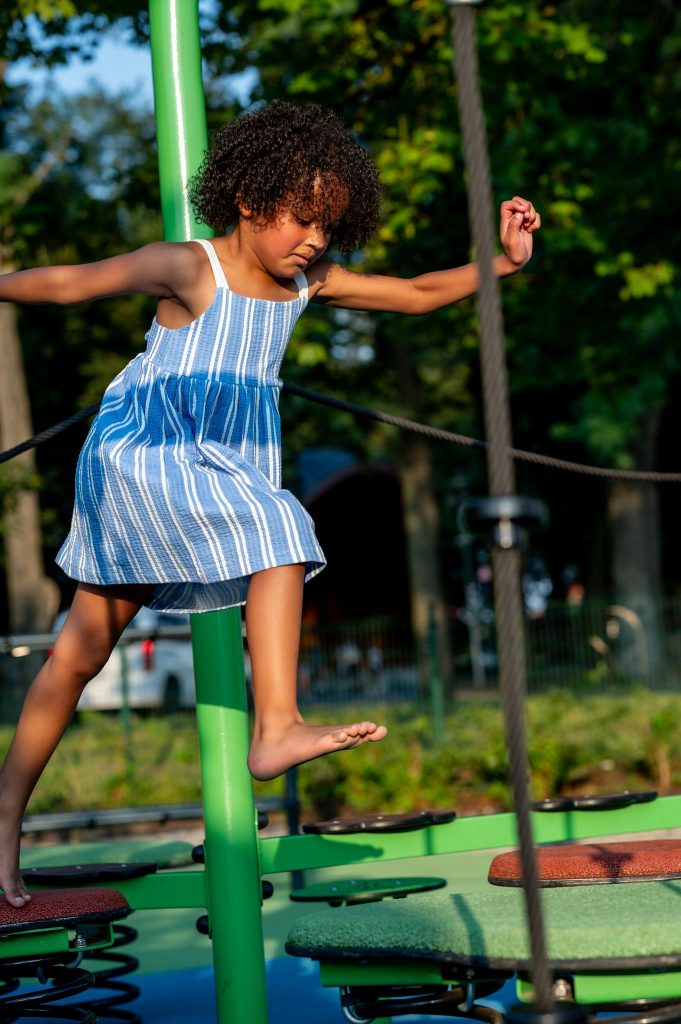
Running, climbing, balancing, slacklining or rope walking, and crossing a wobbly bridge demand far more from a child than simply climbing a ladder and going down a slide. They require estimating distance, planning the next move, maintaining balance, and adapting body posture to an ever-changing obstacle. This is precisely why modern playgrounds are increasingly featuring agility trails, rope climbing structures, and climbing equipment. They provide children with the freedom of movement while creating natural conditions to develop agility, balance, strength, and coordination.
How Does Motor Coordination Development in Children Occur Through Play?
Motor coordination is not a single isolated skill. It encompasses balance control, spatial awareness, movement regulation, and smoothly linking different actions—such as transitioning from running into a leap, or climbing while shifting body weight.
A playground provides the opportunity to nurture these abilities without structured, formal training. The child makes autonomous decisions: which route to take, where to place a foot, how high to reach with a hand, or how to circumvent an obstacle. Research reviews on playgrounds demonstrate that varied elements designed for balancing and climbing offer prime opportunities to cultivate fundamental motor skills, including core stability, agility, and coordination.
Consistency of movement is equally crucial. The WHO recommends that children and adolescents aged 5–17 engage in an average of at least 60 minutes of moderate-to-vigorous physical activity daily. A playground can serve as one of the key environments where such activity emerges spontaneously, without imposing a rigid exercise regimen on the child.
How Do Playground Obstacle Courses Engage the Entire Body?
A classic ladder primarily allows climbing in one fixed direction. An obstacle course, by contrast, presents the child with a series of diverse challenges. It may demand traversing a balance beam, scaling a cargo net, crossing a suspension bridge, hanging from an overhead bar, walking a tightrope, or descending to a lower tier. Consequently, throughout a single play session, movement patterns, pace, and targeted muscle groups constantly shift. The child must continually adapt their movement to the upcoming element.
Playground obstacle courses can incorporate ladders, climbing walls, balance beams, bridges, ropes, and walkways, among other components. Solutions are available across various difficulty levels, tailored for both younger and older users. The structures can also be configured to match the dimensions and layout of the planned space.
A well-designed children’s obstacle course should not merely be a sequence of maximally difficult equipment. Far more engaging is a trail that allows for graduated challenge. An easier section invites less physically confident children to join the fun, while more demanding passages provide experienced users with opportunities to further hone their skills.
Rope Structures on the Playground – What Are the Benefits?
Rope structures demand a much more dynamic full-body response than play equipment built with rigid steps and platforms. A net or rope reacts dynamically to the user’s movement, requiring continuous control of hand and foot placement, muscle tension, and center of gravity while climbing.
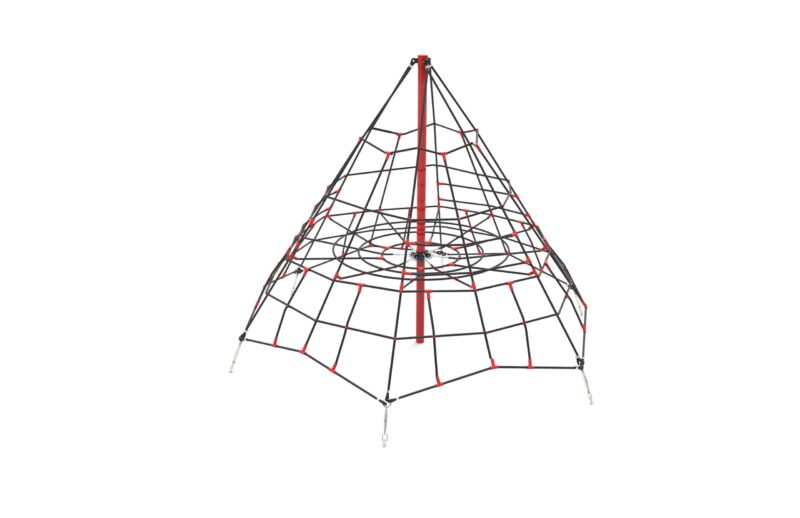
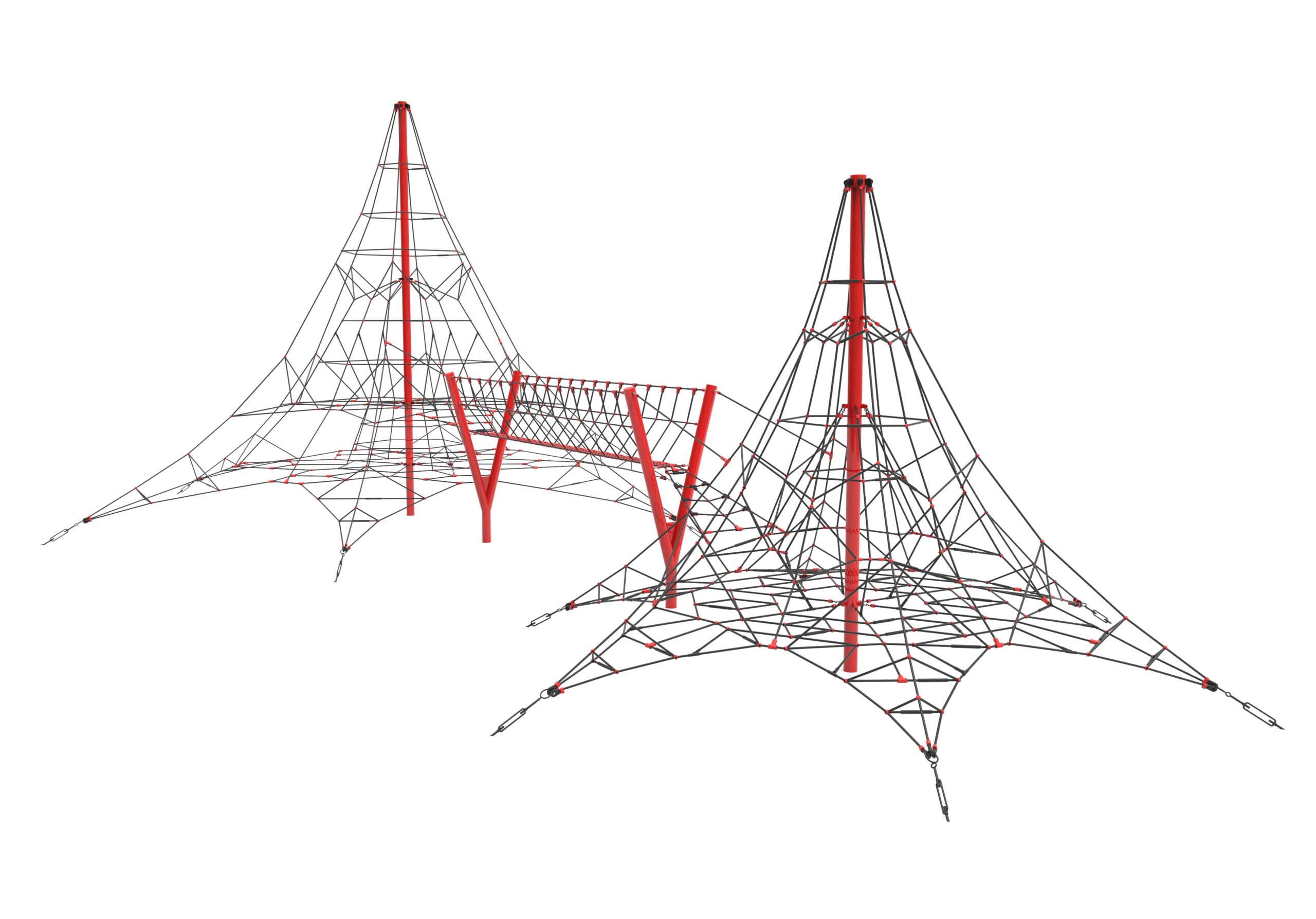
Such structures can take the form of pyramids, spider webs, bridges, tunnels, horizontal nets, or elaborate modular combinations. Available rope play attractions for children can function either as standalone units or as integral components of larger activity zones and obstacle courses.
While navigating a rope structure, a child exercises:
- balance and core body stabilization,
- hand-foot motor coordination,
- grip strength,
- planning subsequent movements,
- distance estimation,
- spatial awareness,
- smooth shifting of body weight.
Development & Sensory Integration
How Rope Play Structures Stimulate Body and Mind
Multi-tiered conditioning through free play at height
The flexible, kinetic net compels muscle and joint receptors to work constantly to maintain body alignment.
The child must gauge distance, anticipate the rope’s movement under load, and sequence handholds.
Simultaneous and alternating use of hands and feet during climbing enhances cross-hemispheric communication in the brain.
Maintaining balance on an unstable surface vigorously activates abdominal, back, and hip girdle muscles.
Safety of rope structures
All rope structures and agility trails are engineered using steel-reinforced polypropylene ropes boasting exceptional tensile and abrasion resistance, in compliance with the PN-EN 1176-1 standard.
Playing on rope structures is directly linked to proprioception, often referred to as deep sensory perception. It is the body’s subconscious ability to sense the position and motion of its individual parts, which is essential for movement control and equilibrium. A child navigating a climbing net does not need to constantly look at every hand and foot placement. Over time, they intuitively learn to modulate their body during shifts in posture, hangs, pull-ups, and weight transfers from one limb to another.
Climbing Develops More Than Just Physical Strength
Climbing is often associated primarily with arm strength. In reality, it engages the entire musculoskeletal system. A child must stabilize their torso, drive with their legs, shift weight, and simultaneously seek out the next point of contact. This is why children’s climbing equipment is a valuable complement to both classic playgrounds and extensive agility zones.
The FreeKids range features playground climbing equipment, including hold walls, ladders, nets, and comprehensive climbing units. Individual products differ in footprint, capacity, and complexity, making it easy to adapt them to target age groups and site limitations. Climbing also introduces autonomous problem-solving. A child sees the objective, but the path is rarely linear. They must identify suitable holds, reposition feet, or choose a viable route. Movement becomes intrinsically linked to continuous decision-making.
If you would like to learn more about equipment supporting balance and coordination development, check out our post: Masters of balance – which playground equipment best develops coordination?.
How to Design a Safe Playground Obstacle Course?
The more expansive an agility zone is, the more critical thoughtful spatial planning becomes. It is not enough to simply place several appealing units side by side. The initial phase should focus on selecting elements appropriate for the age and physical capabilities of the intended users. A playground primarily serving preschoolers requires different fall heights and difficulty levels than an area adjacent to a primary school. It is also beneficial to provide multiple path variations rather than a single rigid route that expects identical motor skills from every child.
The second element involves safety zones (impact areas). Consumer protection authorities (such as UOKiK) emphasize that mandatory clear spaces must be maintained around play equipment, kept free of fences, trees, picnic tables, or waste bins. The equipment supplier should also provide specifications concerning safety clearances, inspection routines, maintenance guidelines, and certificates verifying the compliance of equipment and surfacing with relevant standards.
Furthermore, safety surfacing must be accurately matched to the equipment and its critical fall height. Comprehensive requirements governing playground equipment and impact-attenuating surfacing are outlined in the PN-EN 1176 and PN-EN 1177 standards. Regular post-installation inspections remain equally crucial once the facility is in use.
A modern playground can offer far more than a handful of repetitive activities. Obstacle courses, rope structures, and climbing elements encourage children to experiment with movement. Each crossing can be approached differently—discovering a new route or attempting a more challenging variation.
These solutions are particularly well suited to schools, kindergartens, public parks, and residential developments, where a shared space accommodates numerous children of varying physical skill. Equipment diversity unlocks wider recreational possibilities and enables progressive tiers of challenge.
Looking to Create a Modern Agility Zone?
The right combination of rope climbers, obstacle trails, and climbing walls allows you to build an engaging space for children of all ages. We will help you lay out a cohesive equipment arrangement, calculate mandatory safety zones, and select the optimal impact-absorbing surfacing.