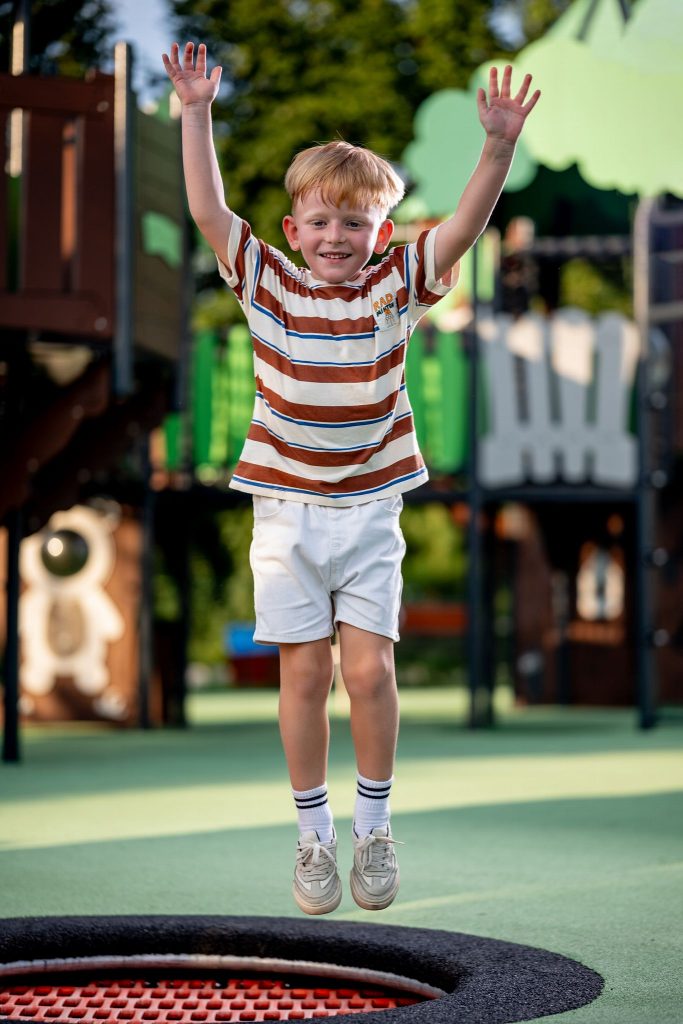
Trampolines are increasingly becoming a fully fledged part of public playgrounds rather than an attraction associated only with the back garden. In-ground models have become particularly popular. They are unobtrusive, easy to integrate into the design of a recreation area, and children need no extra encouragement to use them.
Does this mean, however, that an in-ground trampoline is always a better choice than a traditional, above-ground design? The installation method is not the only thing that counts. You also need to consider the space available, the expected number of users, the surfacing, the impact area and the character of the whole playground. Let’s look at how the two solutions differ and what to pay attention to when planning the investment.
In-ground vs traditional trampoline – what is the difference?
The most obvious difference is the height of the equipment. A classic trampoline stands on a frame raised above the ground. With an in-ground model, the frame and other structural elements sit in a prepared pit, so the jumping mat can be close to the level of the surrounding surface.
This changes how the equipment works within the playground. An in-ground trampoline does not create a tall focal point and can be integrated into the surfacing much like other small play elements. This gives designers more freedom when creating a sequence of different activities, especially where the space is meant to look cohesive and remain relatively open.
However, a traditional trampoline should not be equated with every piece of equipment standing on a frame, and solutions from a private garden should not be transferred directly to a public space. Even a safe garden trampoline is designed for a different type and intensity of use. Equipment intended for a publicly accessible playground should meet the requirements that apply to such spaces.
| Feature | In-ground trampoline | Traditional trampoline |
| Mat position | Close to surface level | Above ground level |
| Integration into the playground | Can form a seamless part of the surfacing and layout of attractions | A more clearly separate piece of equipment |
| Site preparation | Requires a pit and ground preparation | Requires space for the frame and the area around it |
| Access | No need to climb onto a raised mat | Access depends on the design |
| Typical use | Public playgrounds and recreation areas | Depends on the design and intended use of the model |
The installation method should therefore not be the only selection criterion. What matters much more is where the equipment will be used, by how many people and how it is meant to work together with the rest of the equipment.
Why have in-ground trampolines become so popular on playgrounds?
The secret behind their popularity is quite simple. Jumping does not require a child to learn how the equipment works or to come up with a particular play scenario. They can step onto the mat, do a few bounces and run off to the next attraction a moment later. This makes a trampoline a good complement to equipment that engages users in a completely different way, such as towers, ladders, slides or climbing elements.
At the same time, in-ground playground trampolines do not have to mean one standard piece of equipment. The FreeKids range includes round, square, rectangular and hexagonal models, as well as sets made up of several mats. The individual solutions also differ in the size of the required impact area and the number of users. This means the equipment can be matched to a small playground as well as to a large space where trampolines are meant to form a separate activity zone.
Aesthetics also play an important role. A trampoline installed at surface level does not block the view of other equipment or limit the visibility of the space the way a tall structure does. It can therefore be placed between other attractions or in a spot that previously went unused.
Is an in-ground trampoline safer than a traditional one?
The lower position of the mat gives an in-ground trampoline an important design advantage: the user is not on equipment raised high above the surrounding area. This does not mean, however, that every trampoline installed in the ground is automatically safe, or that there is no need to design a proper impact area around it.
Safety depends on the whole layout of the equipment and its surroundings. Factors that matter include:
- correct installation and securing of structural elements,
- keeping the required free space around the trampoline,
- suitably chosen surfacing,
- using the equipment as intended and within the permitted number of users,
- regular inspection of the mat, the structure and the fixings.
In practice, the trampoline should therefore be considered together with the place where it will be installed. The problem may lie not only in the equipment itself but also in a poorly planned access path, a conflict with another attraction or unsuitable surfacing in the immediate vicinity.
What makes a playground trampoline safe?
A low mat position is only the beginning — the equipment’s whole surroundings count
Which standards must a trampoline on a public playground meet?
A trampoline permanently installed on a public playground should be designed and assessed in line with the requirements of EN 1176-1 (including amendment A1), the standard on playground equipment safety. Among other things, the standard covers the design of equipment, the space needed for safe use and reducing the risk of entrapment, falls or collisions with other equipment.
When designing an area with a trampoline, the most important factors are:
- sufficient space around the equipment,
- surfacing matched to the equipment and the possible fall height,
- no hazardous obstacles in the area of use,
- correct installation and securing of structural elements,
- regular inspection of the mat, fixings, structure and surfacing.
For surfacing, EN 1177 (including amendment A1) is also important. It sets out test methods for the impact attenuation of playground surfacing. EN 1176-7:2020, in turn, contains guidance on the installation, inspection, maintenance and operation of playground equipment and surfacing. Trampoline safety should therefore be taken into account during design and installation as well as throughout the playground’s later use.
It is also worth remembering that trampolines intended for domestic use are subject to different requirements. The current EN 71-14 applies specifically to domestic trampolines and does not cover equipment intended for public playgrounds. A model suitable for a private garden should therefore not automatically be treated as suitable for a publicly accessible space.
Find out more in our article: “Playground surfacing – the foundation of safe and accessible play”.
How to choose the right trampoline size and what affects the price?
The price of an in-ground trampoline depends mainly on its size, the number of mats and how the surrounding area is developed. On top of the cost of the equipment itself, you need to add site preparation, digging a suitable pit, installation and the surfacing around the jumping area. That is why two playgrounds using seemingly similar trampolines can differ significantly in the budget for the whole project.
Single models may be designed for one user and require an area of a dozen or so square meters. Larger sets made up of several mats are designed for more users, and the space needed can exceed 60 m².
That is why the choice should start with the question of what role the trampoline is meant to play. On a small playground, it can be an additional activity point between other pieces of equipment. On a large site, several mats can be used to create a distinct zone for active play.
Inclusive trampolines are a separate issue. If the playground is to be accessible to children with different physical abilities, it is not enough to focus on the equipment alone. You also need to consider the access route, the surrounding surfacing, how the specific model is used and how it connects to the other attractions. Accessibility should cover the user’s entire route, not start only at the edge of the trampoline.
How to combine a trampoline with the rest of the playground equipment
A trampoline works well as a contrast to equipment that involves climbing, getting through obstacles or covering a longer route. That is why, when designing a larger space, it can be paired with multifunctional play sets, for example, which combine different activities in a single structure. Children can then move freely from climbing or sliding to a few minutes of jumping, and the playground does not rely on a single type of movement. When expanding an existing space, it is also worth looking at our SINGLE series. It includes stand-alone pieces of equipment that can be used to increase the number of available activities without building a whole new playground from scratch.
You also need to think about the boundaries of the area itself. If the playground is close to a car park, a street, a cycle path or another place from which the children’s area should be separated, panel fencing to secure the play area can help. Its purpose is not to secure the trampoline itself but to organize the space and clearly separate the playground from its surroundings.
A well-designed playground with a trampoline therefore does not start with the question of the mat’s shape or color. First, you need to determine who will use the space, how much room is available and which activities are missing from the planned or existing layout. Only then can you choose a model that genuinely complements the playground rather than becoming a randomly added element.
We will advise you on whether an in-ground or a traditional trampoline is the better choice, and design an installation that meets the safety standards required for public playground equipment.