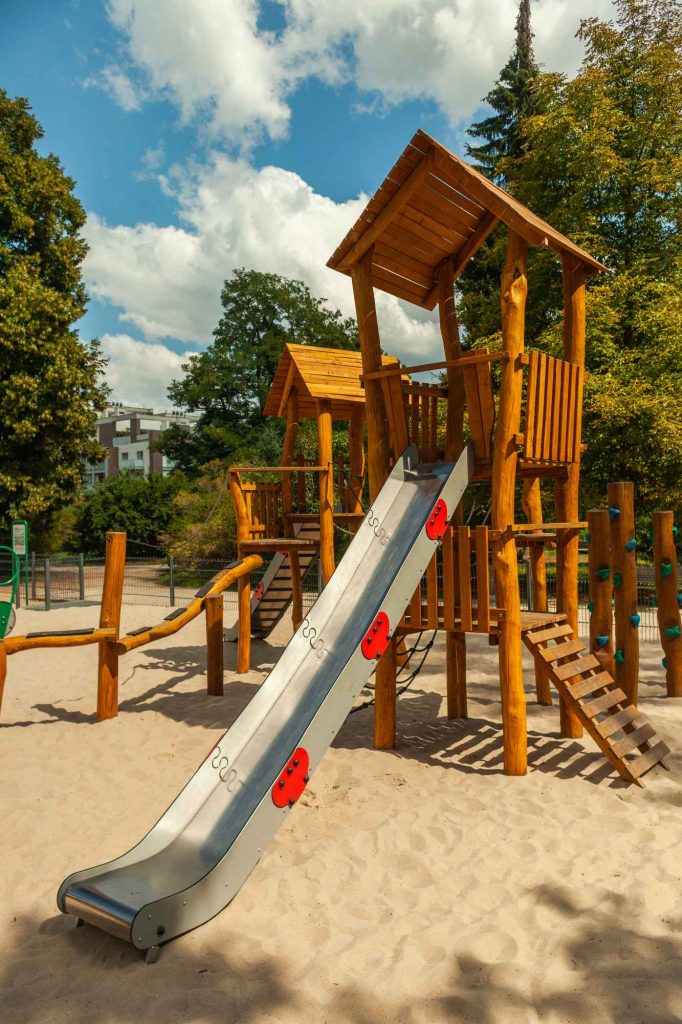
Modern playgrounds are increasingly designed not to dominate their surroundings, but to blend naturally into the landscape. In parks, forests, community gardens, or near recreational facilities, structures that harmonize aesthetically with the environment work best. This addresses the needs of children, who develop most fully in spaces that stimulate their imagination and expose them to organic shapes.
FreeKids’ product line addresses these needs with two unique—though technologically distinct—series: the fully natural, wooden Robin Wood series and the extremely durable Tree House series, inspired by forest cabins and combining metal and HDPE panels.
Wooden Playgrounds – A Classic
Today’s playground market largely favors metal structures due to their exceptional durability and minimal maintenance requirements. Although classic wood is less common in modern urban designs, it still holds a unique and prestigious place in recreational areas.
Currently, the strongest and most sought-after trend in natural playground architecture is the use of black locust (acacia) wood. Our flagship Robin Wood series is based on this exceptionally durable material.
For lovers of traditional wood, the FreeKids lineup also includes other themed series, such as Farm, Castle, Hop! Wood, and Slavia, which allow you to create cozy and eco-friendly recreational areas.
The key advantages of wooden structures from the Robin Wood line include:
the exceptional weather resistance of natural robinia wood,
a harmonious, unobtrusive blend with the surrounding greenery,
a warm and inviting sensory experience that stimulates children’s development,
a calmer, more organic character of the play area.
The Robin Wood Series – naturalness, durability, and minimalist aesthetics
The Robin Wood series was designed for spaces intended to look timeless and eco-friendly. The structures are made of robinia wood, valued for its hardness and natural resistance to moisture and biodegradation—without the need for harsh chemical preservatives.
This series includes both elaborate climbing sets and smaller elements, such as swings and spring riders. Characteristic of Robin Wood are irregular, organic forms (naturally curved trunks), visible grain patterns, and subdued, forest-inspired colors. Rope elements also play a major role here, as they develop motor coordination and lend the structures a sense of lightness. As a result, these play structures blend into the landscape, encouraging children to explore freely and play close to nature.
The Tree House Series—a modern take on a forest adventure (metal and HDPE)
Although the Tree House series brings to mind classic wooden treehouses at first glance, technologically it represents a completely different, modern approach. These structures are made of metal and highly durable HDPE panels.
This is an excellent solution for investors seeking a natural, forest-like atmosphere (e.g., for a park, resort, or modern housing development), but for whom maximum durability, resistance to vandalism, and the absence of the need for regular wood maintenance are top priorities.
Thanks to this combination, the Tree House series offers:
Extreme durability: The metal structure and HDPE panels are nearly completely resistant to moisture, frost, UV radiation, and heavy use.
Safety and no splinters: The smooth surfaces of the composite materials eliminate the risk of scratches, make cleaning easier, and do not require repainting.
A unique atmosphere: Towers styled to resemble forest outposts, rope bridges, hidden slides, and platforms at various heights spark children’s imaginations and give them the feeling of experiencing a real adventure.
The Tree House series is ideal for theme parks, resorts, forest recreation areas, and modern urban spaces with high usage intensity.
How to design a playground in a forest or park?
Designing a playground in a natural setting requires striking a balance between the functionality of the equipment and the aesthetics of the environment. Whether you choose the Robin Wood line or the modern Tree House series, it’s important to keep a few principles in mind:
Integration with greenery: A good design makes use of existing trees, hills, and natural shade rather than removing them.
Organic spatial layouts: Forest playgrounds should avoid rigid symmetry. Irregular paths, varying levels, and natural exploration zones work better.
Consistent color scheme: Choose muted colors (browns, greens, grays) that harmonize