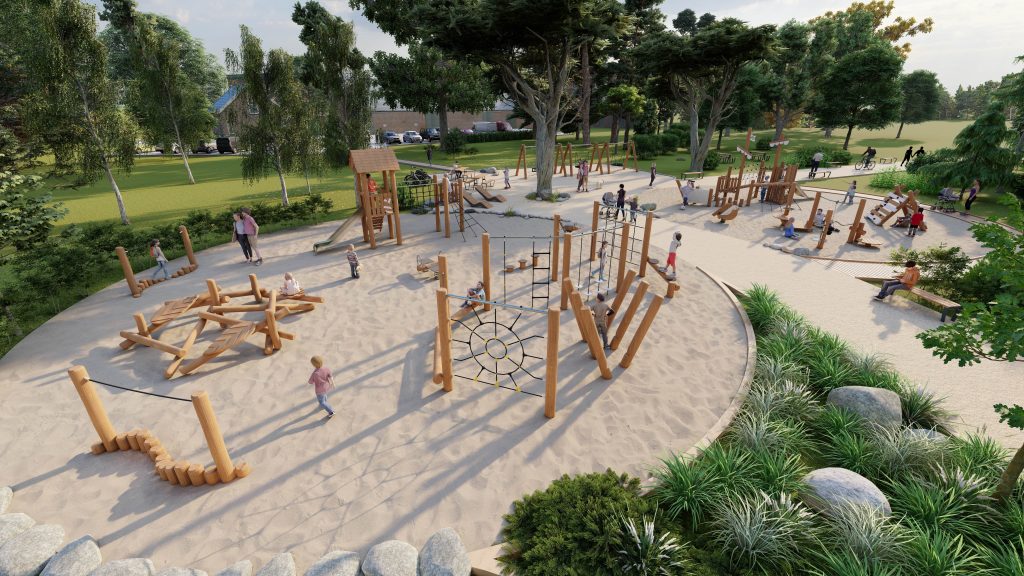
In 2026, municipalities and childcare institutions can count on various forms of financial support intended for the creation and modernization of playgrounds. This is a real opportunity to develop safe, functional, and attractive spaces for the youngest. Available funding programs cover both the construction of new facilities and the modernization of existing infrastructure. In this article, we will look at where funds can be obtained, what the application process looks like, and what to consider when planning a playground investment.
Which entities provide funding for playground construction?
The Ministry of Family, Labor, and Social Policy plays an important role in funding the construction of playgrounds. Funds for this purpose come from the Labor Fund and go mainly to municipalities that provide care for children up to three years of age, including through nurseries and children’s clubs. This also applies to external companies operating such facilities under municipal contracts. If you want to apply for funding, you must meet specific conditions:
- operating facilities with fees of up to PLN 1,500 per month,
- in the case of children with a disability certificate, fees not exceeding PLN 1,900,
- using only one funding program for a given playground project.
Apart from government funds, it is also worth looking for support in regional programs such as the Physical Culture Development Fund or sports programs like “Mazowsze dla Sportu” (“Mazovia for Sports”). These initiatives help local government units and physical culture institutions develop recreational infrastructure, including the construction of playgrounds. Thanks to this, many different institutions can secure funds to create or modernize recreational spaces for children.
Under which programs can you apply for funding?
If you are planning to build or modernize playgrounds in 2026, you have, among other options, the government program “Active Playgrounds 2026” at your disposal. This program, created by the Ministry of Family, Labor, and Social Policy, offers financial support of up to PLN 300,000 for each institution. You can allocate these funds for both new playgrounds and the improvement of existing spaces next to nurseries or children’s clubs. This is possible thanks to funding from the Labor Fund, with the goal of providing safe and modern play areas for the youngest children.
In addition, the Ministry of Sport and Tourism also supports sports and recreation investments. You can benefit from the Physical Culture Development Fund (FRKF), which assists local governments in financing recreational spaces such as outdoor gyms or playgrounds. Usually, funding covers around 30% of the project value.
At the regional level, there are programs like “Mazowsze dla Sportu”, which can cover up to 75% of eligible costs. This is a massive help for local governments planning to expand infrastructure, such as skateparks, or modernize sports fields. In such cases, the support can reach even over PLN 300,000.
In summary, the main sources of funding for playground-related projects are:
- the government program “Active Playgrounds 2026” from the Ministry of Family, Labor, and Social Policy,
- funds from the Ministry of Sport and Tourism under the Physical Culture Development Fund,
- regional programs, such as “Mazowsze dla Sportu”.
By combining these sources in your playground investment plans, you can significantly increase your financial capabilities and carry out projects that would otherwise be difficult to execute. If you want to obtain such funds, it is worth regularly monitoring program availability and current application requirements.
What criteria must a playground project meet to qualify for funding?
To receive funding from the Active Playgrounds 2026 program, a playground project must meet several important criteria. The playground should be accessible year-round and feature durable structures that can withstand various weather conditions. In addition, key requirements include:
- at least 20% of the area should be shaded,
- another 20% must be biologically active, promoting the creation of a natural play space,
- projects must include different thematic zones,
- the playground should be accessible to all children,
- promoting development and social integration.
These requirements help ensure long-term accessibility of the playground for all users while protecting the natural environment.
Design principles
Designing a playground is a task that is worth approaching creatively. The main goal is to create diverse spaces that will inspire children to play. Such a concept helps stimulate their creativity, imagination, and cooperation skills. The playground should have at least three distinct thematic zones. This layout supports the development of children’s various skills and interests.
The durability of structures is highly important. The playground should be resistant to rain and sun, which will ensure its long lifespan. Incorporating trees or lawns into the design not only enhances aesthetics but also encourages children to play outdoors and think ecologically. Do not forget about the ease of monitoring and maintaining the equipment. It is important that the used products allow for easy inspection of the equipment’s condition and servicing. This will reduce the risk of accidents and improve children’s safety. This approach not only makes it easier to obtain funding but also creates friendly and useful spaces for both children and the entire community.
If you want to delve deeper into the topic and see how to approach creating a functional space for the youngest step by step, check out the article “How to design a modern playground…”, in which we discuss the key elements of design in more detail.
Certification and compliance with standards
For a playground to qualify for funding and be safe for children, it must meet specific standards and obtain certification. The EN 1176 and EN 1177 standards are crucial, as they define the requirements for equipment and surfacing. This is critical when it comes to user safety. The key aspects ensuring safety and eligibility for support include:
- the durability of structures and their resistance to various weather conditions,
- using natural surfacing as much as possible,
- certification confirming compliance with standards,
- reducing the risk of injury through appropriate surfacing,
- the safety of equipment.
The certification process guarantees that all elements of the playground comply with requirements, which ensures the safety of the equipment and minimizes the risk of injury on the surfaces. Consequently, the playground not only secures funding but also becomes a friendly and safe place for children. To meet the requirements, every new or modernized playground should undergo certification confirming compliance with standards. This is an essential step in seeking financial support and subsequent use.
Safety inspections
Regular inspections are necessary to ensure that playgrounds remain safe and comply with current standards. Under the “Active Playgrounds 2026” program, in accordance with the EN 1176 and EN 1177 standards, playgrounds must undergo various types of inspections. The key ones include:
- monthly routine visual inspection,
- more detailed operational inspection every 1-3 months,
- annual main inspection conducted by independent experts,
- detailed inspection every 5 years in accordance with Construction Law.
A visual inspection consists of a quick check for visible equipment damage and potential hazards. An operational inspection tests the function and stability of all components. The annual main inspection is carried out by specialists who evaluate the entire playground and its compliance with standards. Once every 5 years, an extensive inspection is also required in accordance with Construction Law. Such actions help to quickly identify potential issues, which minimizes the risk of accidents and damage. Regular maintenance and inspections can significantly extend the lifespan of playground equipment.
Applying for funding – what did the process look like in the previous edition of “Active Playgrounds 2026”?
Under the “Active Playgrounds 2026” program, clearly defined rules applied regarding application submission, deadlines, and required documentation. Although the intake for this edition has already closed, it is worth looking at how it proceeded, as many indicators suggest that similar initiatives may emerge in the coming years.
In the previous call for proposals, applications were accepted exclusively in electronic form, via the ePUAP or e-Doręczenia platforms. The application had to be submitted to the appropriate voivode. The intake lasted from November 7 to December 19, 2025, which meant a relatively short window to prepare full documentation.
The application had to be accompanied by, among other things:
- a document confirming legal title to the property,
- an extract from the land register,
- a detailed description of the planned task along with a cost estimate,
- information regarding the accessibility of the playground for children from outside the given institution.
If acting through a proxy, it was also necessary to attach appropriate authorizations.
Submitted projects were verified at the voivodship office level, and then the recommended applications were forwarded to the Ministry of Family, Labor, and Social Policy. The schedule assumed transferring them to the ministry by January 9, 2026, and the announcement of results took place by January 23, 2026.
The program did not require a financial co-payment (own contribution), and the implementation of the investment was scheduled for the entire year of 2026, from January 1 to December 31.
It is worth emphasizing that many of these requirements are not specific only to this program. Similar rules apply when applying for funds from other sources, both national and EU-based. Timeliness, complete documentation, a precise project description, and a reliable cost calculation are elements that almost always influence the application assessment. Therefore, even if a specific edition has already closed, the experience gained and the materials prepared can prove highly useful for future calls.
If you are planning to create a playground tailored to the specific needs of your municipality or institution, it is worth choosing proven solutions. Properly selected equipment, a well-thought-out zone layout, and compliance with current standards are of great importance, both for safety and the functionality of the space. If you are looking for a playground model tailored to your requirements, check our catalog and see how we can help you carry out your investment from the initial idea to the finished project.