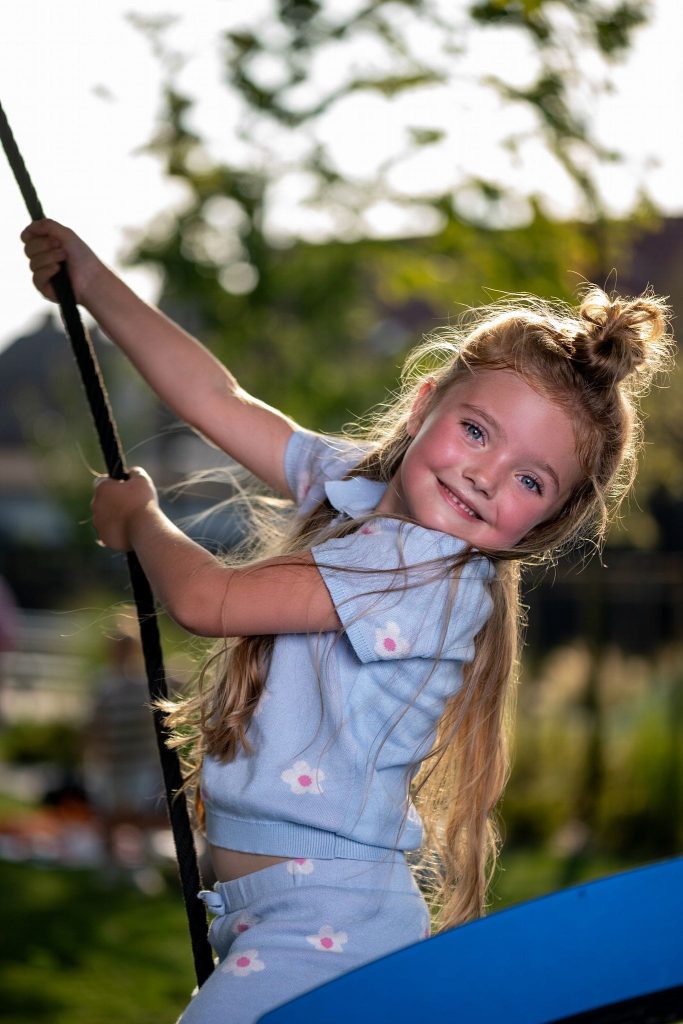
On a well-designed playground, not every piece of equipment attracts the same level of interest. Swings, slides, and climbing structures make up its core equipment, but it is often at the zip line that the longest queue forms. A cableway provides children with something static equipment cannot offer: speed, motion above the ground, and thrills reminiscent of a true adventure.
What is a playground cableway (zip line)?
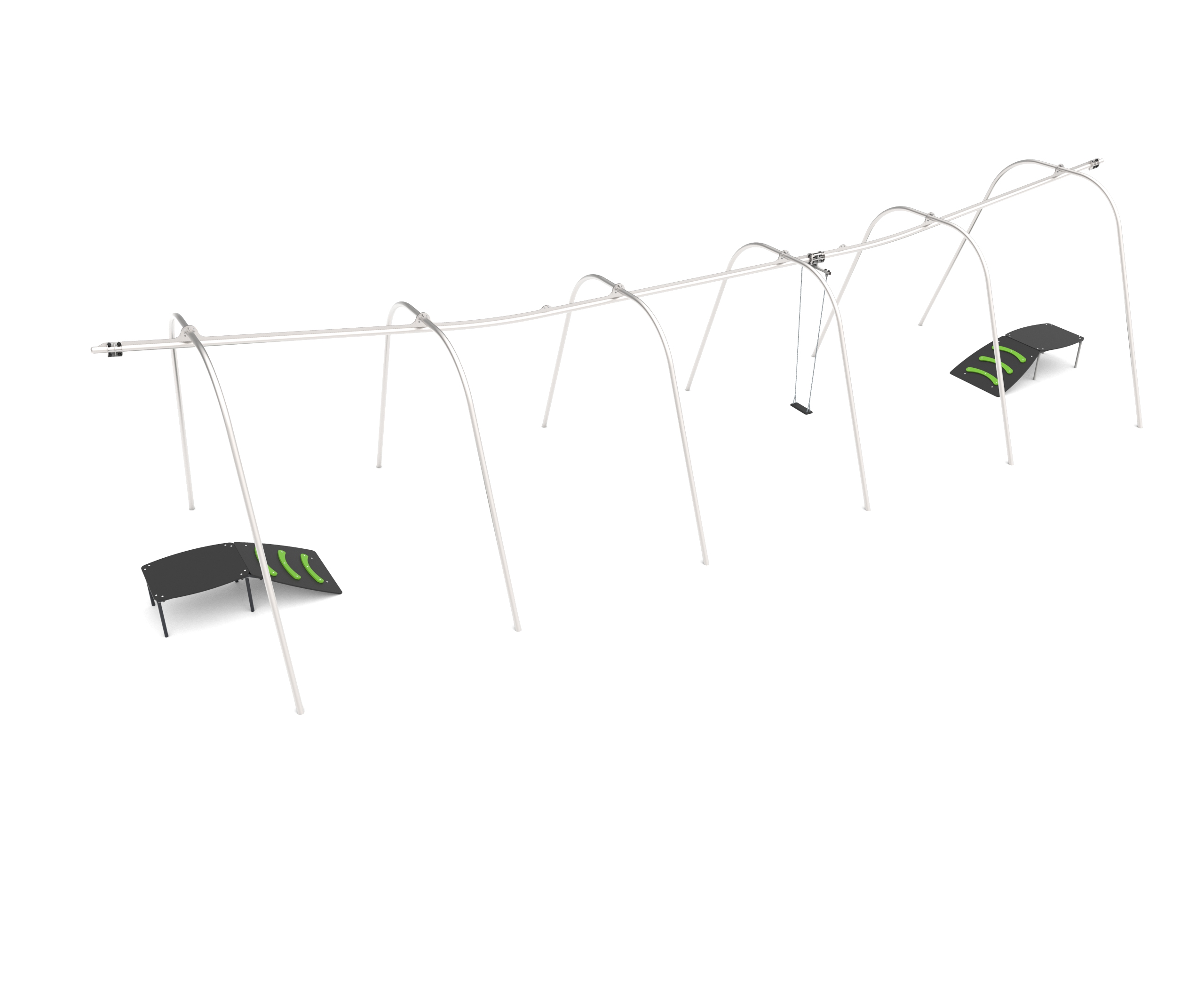
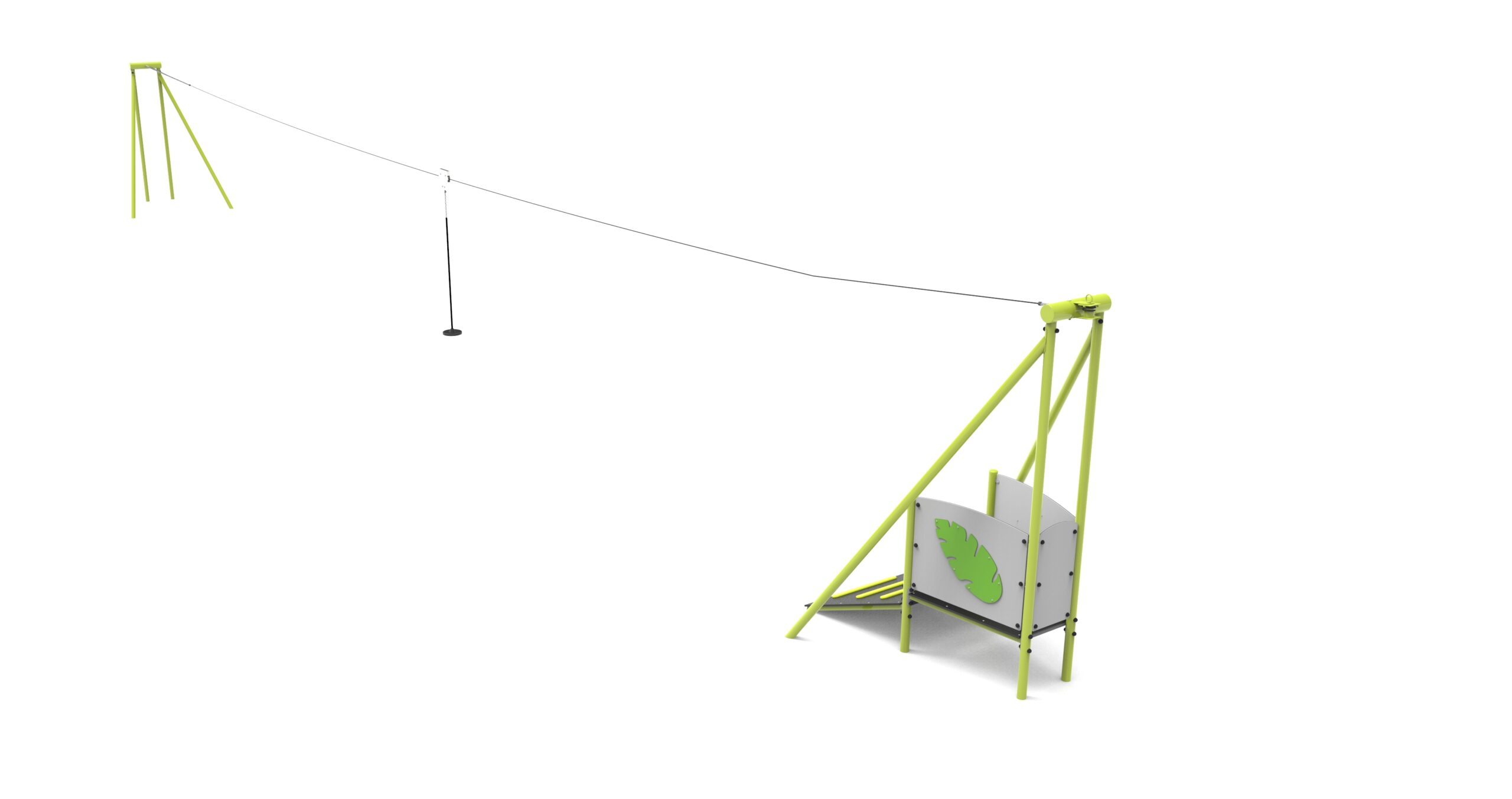
A cableway, commonly referred to as a zip line or aerial runway, is a piece of play equipment on which the user travels along a tensioned cable by force of gravity. A child takes a seat, pushes off from a platform or the ground surface, and glides along the designated run.
The core components of the equipment include a load-bearing support structure, a steel cable, a trolley mechanism, a seat, and a braking system ensuring a safe stop. Depending on the design, the zip line can be equipped with a starting platform or start directly from an appropriately prepared ground surface level.
Why do children love using the zip line?
A zip line ride is brief yet intense. The child experiences acceleration, movement above the playground surface, and a controlled stop. Each ride has a distinct start and finish, which encourages immediate repetition.
The zip line also provides a safe way to test one’s courage. The first ride may cause some hesitation, but subsequent attempts help children overcome their fear of speed and height. Children decide for themselves when they are ready to launch, gradually building confidence in their own abilities.
It is one of the most valued playground attractions for older children. School-aged users often need equipment that offers more movement, dynamism, and excitement than play structures designed for toddlers. The zip line meets these needs while remaining fully aligned with the recreational function of the playground.
Want to learn more about the construction, operation, and application of this equipment? Be sure to read our article: What is a cableway?.
The zip line as coordination and fitness training
Using a zip line requires performing a sequence of actions. A child must step up to the starting point, sit down properly, grip the equipment handles, maintain their posture during the ride, and safely dismount from the seat at the end. During this activity, muscles of the hands, arms, core, and legs are actively engaged. The user stabilizes their body, reacts to the motion of the seat, and adjusts their posture to the changing speed. The activity thus supports the development of balance, spatial awareness, grip strength, and hand-eye coordination.
Equally important is the repeatability of the activity. Children rarely stop after just one run. They return to the start, get back into position, and attempt to perform the entire movement with greater confidence. This natural desire for another ride means physical exercise takes place spontaneously, without any imposed routine.
The zip line promotes peer interaction
While the equipment is typically used by one person at a time, the play surrounding it has a social dynamic. Children watch each other ride, take turns, help pass the seat back to the start, and remind one another when it is safe to begin the next run.
In doing so, they learn patience and respect for the rules of shared play. The zip line can become a central gathering spot where users spontaneously form a group. Younger children observe their more experienced peers, while older ones often offer advice on how to sit or prepare for the launch.
Such interactions are vital in residential, school, and park settings. A modern playground should not only facilitate individual physical movement, but also encourage relationship building and collaborative play.
How long should a playground zip line be?
There is no single length that suits every playground. This parameter should depend on the equipment model, terrain topography, the intended user group, and the available surface area combined with the required safety clearance zone.
A longer track may provide a more exciting ride, but it requires an adequately large and properly prepared area. Equipment cannot be evaluated solely by the length of the cable itself. The starting point, braking distance, space beyond the end of the run, and obstacle-free lateral zones must all be taken into account.
An example model from FreeKids has physical equipment dimensions of approximately 25.13 × 2.20 m, while its full impact area covers around 28.08 × 5.26 m. This demonstrates that the space required for safe installation is significantly larger than the travel track itself. The specific length should therefore be determined during the design phase, following site measurements and an analysis of the chosen equipment’s technical documentation.
Cableway (Zip Line) at a Glance
Key parameters and impact on child development
Equipment Dimensions vs. Safety Zone
A cableway requires a significantly larger protective area than the physical dimensions of the steel structure alone.
Approx. 28.08 m × 5.26 m
Approx. 25.13 m × 2.20 m
How does a zip line support child development?
Strengthens arm, core, and leg muscles while building grip strength.
Develops spatial awareness and the ability to maintain balance in motion.
Teaches patience in queues, cooperation, and mutual assistance at launch.
What safety standards must a playground cableway meet?
Cableways installed in public playgrounds must comply with the requirements of the EN 1176 series (in Poland: PN-EN 1176). Specific safety requirements and test methods for cableways are set out in EN 1176-4. The standard covers permanently installed equipment on which children travel along a cable by force of gravity.
During the design and commissioning phases, the following aspects are evaluated:
- the construction and stability of load-bearing components,
- the operation of the trolley mechanism and braking system,
- the design and execution of the seat and starting point,
- the free clearance space along the travel path,
- the safety impact area and surfacing properties,
- the risk of entrapment of body parts or clothing.
A safe zip line is therefore not merely a cable stretched between two uprights. It is a complete piece of equipment engineered as an integrated system in which length, gradient, travel speed, braking, height above ground, and surrounding clearances must all be properly coordinated.
Compliance with the standard is essential, but safety also depends on correct installation and ongoing maintenance. Even a well-engineered structure can fail to operate properly if the cable loses tension, the trolley mechanism wears out, or obstacles appear within the travel corridor.
The playground operator must conduct inspections in accordance with the manufacturer’s instructions. These include routine visual inspections, detailed operational inspections, and periodic main inspections. Components requiring close checks include the cable, trolley, fixings, seat, braking elements, foundations, and impact-absorbing surfacing. Organizing the surrounding space is equally important: the travel path must not cross pedestrian walkways or terminate where other children are playing. Clear access to the start and finish must also be ensured so waiting users do not enter the track before a ride is complete.
Where is the best location to place a zip line?
A cableway requires a longitudinal strip of land of adequate dimensions. It works particularly well along the perimeter of a playground, where its safety zone does not cut across pathways leading to swings, slides, or multi-play towers.
Location must be analyzed within the context of the entire space. Ground level variations, soil type, and the presence of trees, fences, benches, lamp posts, and other play structures are all critical factors. The designer should also anticipate where children will queue and along which path users will return to the start after finishing their ride. A zip line can form part of a zone dedicated to older children, situated alongside rope pyramids, obstacle courses, or climbing structures.
Manufacturer-designed cableways tailored to your space
When selecting a cableway, it is worth examining not only the equipment’s aesthetic appeal, but also its documentation, age rating, safety zone footprint, and installation requirements. Materials resistant to heavy use and adverse weather conditions are equally crucial.
Cableway models from FreeKids are designed for users aged 5 to 14. The construction incorporates protected steel elements, a steel cable, a durable synthetic seat, and platforms made of anti-slip plywood or HPL board. The equipment declares compliance with EN 1176 (PN-EN 1176).
As a commercial playground equipment manufacturer, we support investors in choosing equipment tailored to their site conditions and overall project objectives. Our available cableways and zip lines can be incorporated into school, housing estate, park, and recreational spaces.
To ensure the equipment performs its function properly, it should be accounted for as early as the playground design stage. Selecting the right model based on available space, properly delineating the safety impact area, and planning routine inspections allow you to combine thrilling play with strict safety compliance.
Planning to build a modern playground with a zip line?
Proper positioning of the cableway, selection of impact-attenuating surfacing, and maintaining required safety clearance zones are the keys to a successful investment. Our experts will help you adapt FreeKids equipment to your site conditions free of charge, ensuring full compliance with the PN-EN 1176 standard.