Starting your first street workout, you enter a world of activity that allows you to build strength and fitness in the open air. This is an excellent form of exercise, but in the beginning, it is easy to get discouraged – especially without a plan and proper basics. Therefore, it is worth taking it slow. Define your goals, maintain consistency, and focus on simple exercises. A well-planned start ensures that street workout for beginners becomes a pleasure rather than a source of frustration.
What is a street workout and why is it worth training outdoors?
Street workout is a modern form of strength training based on working with your own body weight. You can train practically anywhere – in your neighborhood, in a park, or at free outdoor gyms. It is a combination of calisthenics, gymnastics, and functional training that develops strength, endurance, flexibility, and coordination.
The benefits? Not just physical:
- improvement of fitness and muscle strength,
- better well-being and stress reduction,
- a natural dose of vitamin D,
- better recovery thanks to fresh air,
- greater motivation for regular training.
Street workout also motivates in practice:
- training among people adds energy and mobilizes to action,
- availability of equipment (bars, parallel bars) allows for a variety of bar exercises,
- the possibility of gradual progress brings satisfaction and visible results.
As a result, street workout training is not just a way to get fit, but also a lifestyle that is easy to maintain for the long term.
How to start street workout training if you are a beginner?
When starting your adventure with street workout, first assess your current physical fitness. Before beginning your training, check how many pull-ups you can do, how long you can hold a plank, and what your general capabilities are. This will give you a clear starting point and help you avoid overexertion at the beginning. Do not forget that a solid warm-up is essential. It protects against injuries and prepares muscles for effort.
To start, choose simple base exercises:
- push-ups,
- pull-ups assisted with resistance bands,
- squats.
Learning correct technique is a crucial element. Focus particularly on strengthening the core muscles – they are responsible for stabilization and will allow you to progress to more advanced exercises in the future. It is best to train about three times a week, giving your body time to recover. On rest days, it is worth adding stretching, which improves mobility and reduces the risk of overload.
If you do not know how to start, a ready-made training plan for beginners is a good solution. It allows you to gradually increase the intensity and introduce new elements, such as the L-sit or muscle-up.
Maintain a flexible approach – not everything has to work out right away. In street workout, consistency and progress are the most important factors. To start, it is also worth finding a training group or a more experienced person. Training together increases motivation and helps master technique faster.
Basic exercises on bars and parallel bars
Exercises on bars and parallel bars are the foundation of street workout training. They develop both strength and endurance.
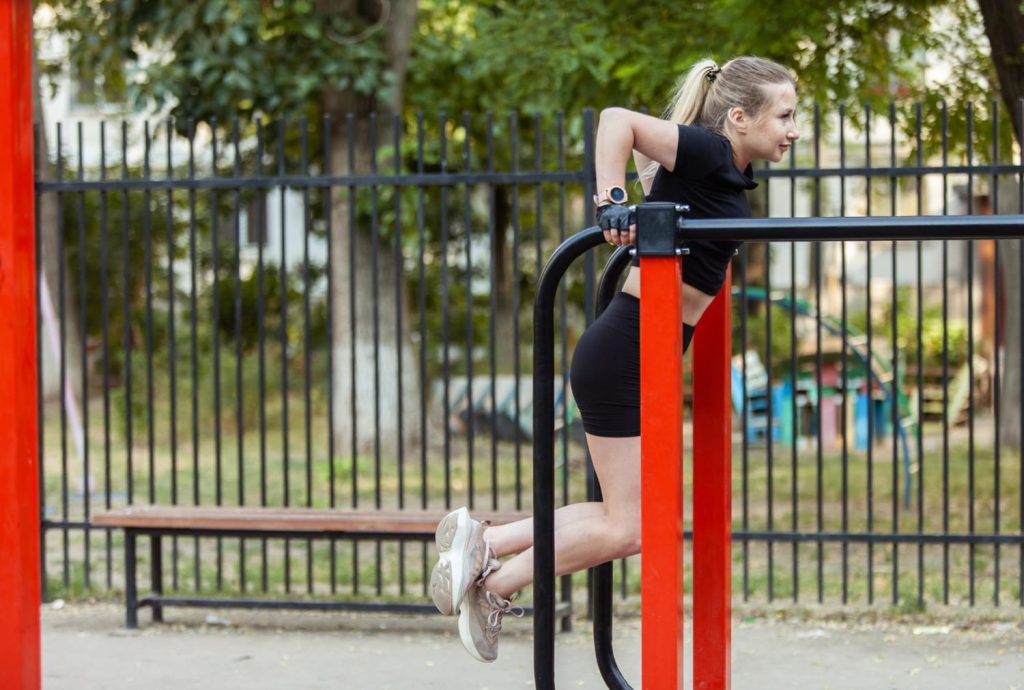
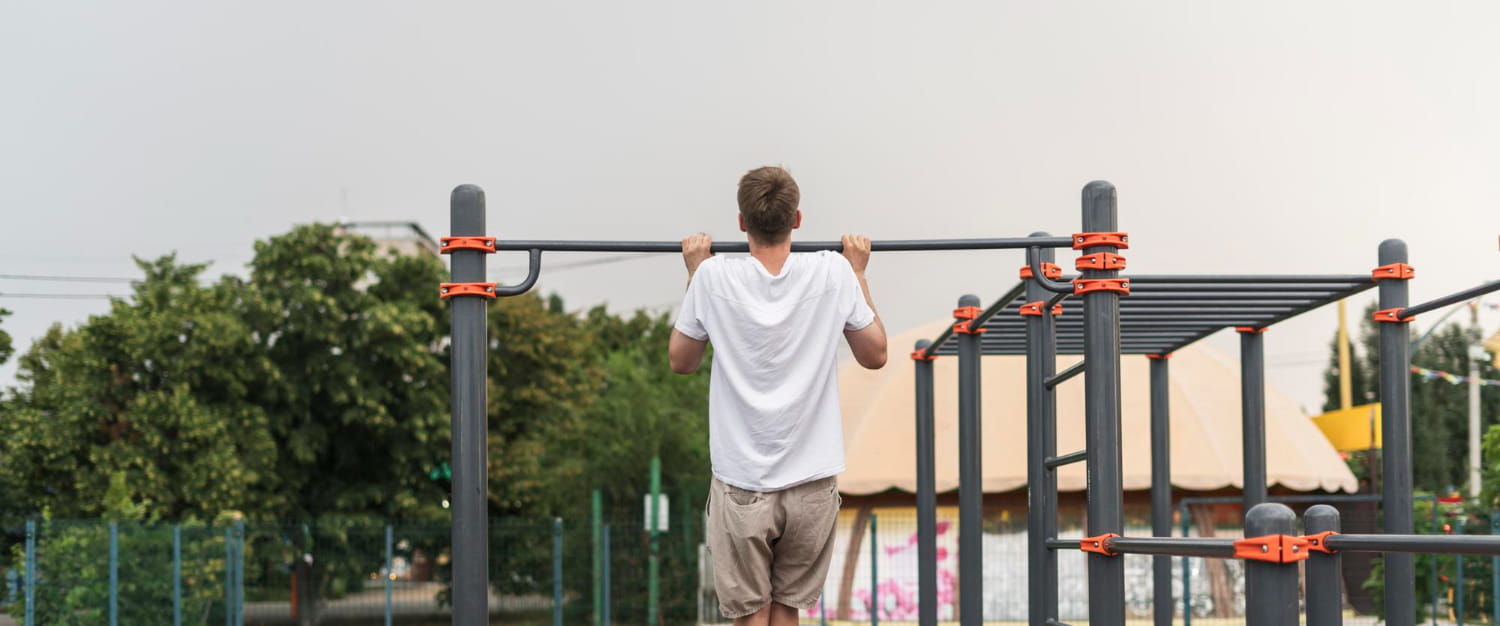
One of the most important exercises is the pull-up, which engages the back, shoulder, and bicep muscles. To start, it is worth choosing easier variations, such as Australian pull-ups or pull-ups with resistance bands. Another element is parallel bar dips, which strengthen the chest and triceps. If this is still too difficult for you, you can perform them with your legs supported on the ground. The plank, on the other hand, is a great exercise for core muscles, which are responsible for stabilization and proper movement technique.
Other basic exercises on bars and with body weight include:
- hanging leg raises,
- squats,
- balancing exercises on parallel bars.
These elements help build stabilization and arm strength.
At the beginning, choose simpler versions and gradually increase the difficulty as you progress. Regular training and observing the effects are the foundation of development. Consistency will allow you to build a solid base for more advanced elements. Over time, you can increase the intensity, which will translate not only into better fitness but also greater satisfaction from training.
Technique and safety – how to avoid injuries at the start?
Technique in street workout is extremely important, as it helps avoid injuries and increases the effectiveness of exercises. Remember to pay attention to your posture and how your body works. Keep your alignment straight and perform full-range movements. It is worth exercising at a slow pace, controlling every movement – e.g., 3 seconds for the contraction phase and 5 seconds for stretching.
Do not forget about the warm-up, which is an inseparable element of preparation for training. A well-performed warm-up allows muscles and joints to safely transition to more intense work, reducing the risk of injuries and muscle soreness. Start with dynamic stretching and light cardio to stimulate blood circulation.
To avoid injuries, increase the difficulty of exercises gradually. This will reduce the risk of overloads and allow you to develop in a safe way. Remember that pain is a signal from the body – in such a situation, it is worth taking a break and making sure your technique is correct.
Recovery is also a highly important element of training. A good diet and an adequate amount of sleep support the body’s rebuilding process, helping it cope better with exertion. Training must be balanced with rest, which translates into better results.
If you are not sure how to exercise correctly, it is worth using the help of an experienced trainer or instructional materials. This will provide you with valuable tips and increase the safety of your training. Exercising with more experienced people also brings additional motivation and faster progress.
Simple street workout training plan for beginners
If you are just starting your adventure with street workout as a beginner, it is a good idea to create a simple plan that will help you build strength and endurance.
To start, try to exercise 3 times a week, leaving at least one day for rest between sessions. This will help you avoid overloading and overtraining – which is particularly important at the beginning when you are just getting used to spaces such as calisthenics parks or free outdoor gyms.
Divide your training into three days and assign a different goal to each. Here is what is worth paying attention to:
- Day 1: dynamic strength – focus on movement and exercises that build strength,
- Day 2: static strength – work on holding positions, which strengthens muscles,
- Day 3: muscular endurance – perform exercises until you feel muscle fatigue.
Start each training session with a 5–10 minute warm-up, e.g., a light jog or jumping rope. After finishing the session, spend some time stretching – this accelerates recovery and improves mobility.
Over time, you can increase the intensity of your workouts by adding more sets or choosing more difficult bar exercises and elements utilizing gymnastic wall bars, which greatly support the development of strength and coordination. Thanks to consistency, you will quickly notice progress while avoiding injuries.
Weekly training schedule for beginners
| Training day | Main goal | Example exercises |
|---|---|---|
| Day 1 | Dynamic strength | Classic push-ups, squats, Australian pull-ups |
| Day 2 | Static strength | Plank, L-sit hold, active hang on the bar |
| Day 3 | Endurance | Higher number of push-up and squat repetitions (until fatigue) |
| Remember: Start every workout with a 5-10 min warm-up, and end with stretching. | ||
Progress and consistency – how to maintain results and motivation?
Progress in street workout relies on gradually increasing the difficulty and intensity of exercises. Consistency is key – it is best to exercise 3 times a week, especially if you treat this sport as a permanent element of your activity. Indeed, systematic training translates into real results: greater muscle strength, better endurance, and improved coordination.
From the very beginning, it is worth keeping a training journal, which will allow you to track progress and more easily introduce necessary changes.
To maintain motivation:
- set specific goals (e.g., more repetitions in pull-ups),
- introduce new exercises and techniques,
- train in a group – this increases engagement and provides extra energy.
Do not forget about recovery. A proper diet rich in protein and carbohydrates, as well as an adequate amount of sleep, are inseparable components of training. Resting between sessions gives your body time to rebuild and strengthen. Regular challenges, such as increasing the difficulty level or adding new movements, not only bring satisfaction but also guarantee continuous development.
If you feel you have plateaued at one level, try introducing:
- minor adjustments in exercise technique,
- changes in the training structure or phases.
Sometimes small modifications can bring entirely new results and restore motivation to act.