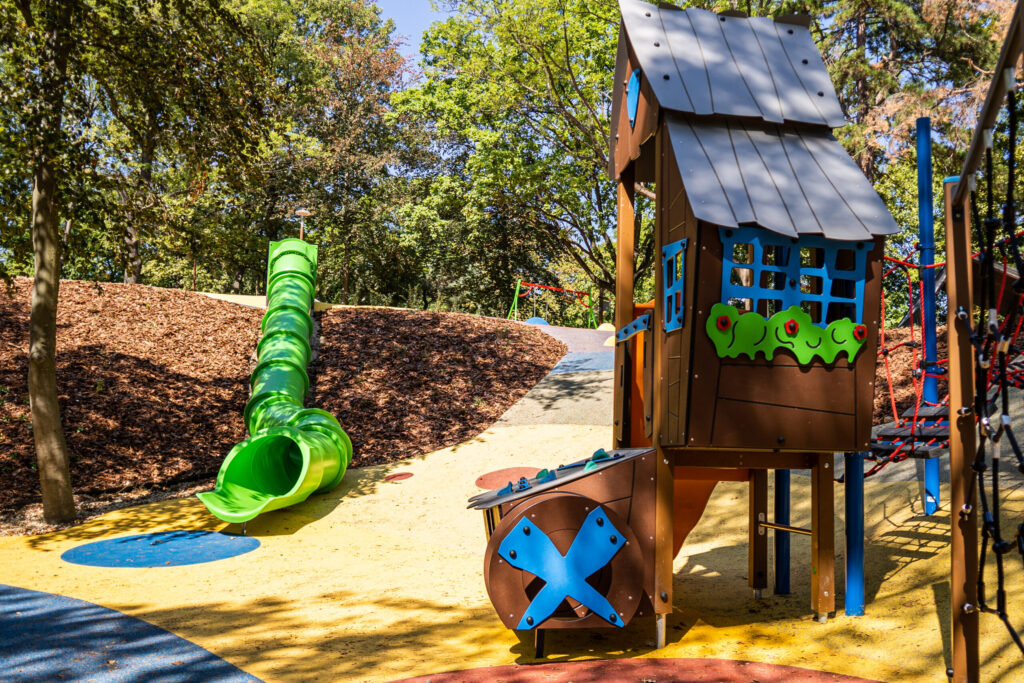
Sloping terrain with distinct elevation differences often seems like an obstacle when designing a playground. However, leveling such a site can entail costly earthworks, the need for retaining walls, and the loss of its natural character. An alternative approach is to treat the embankment or slope as the central element of the entire design concept. A properly developed hill or slope can serve as the play structure itself. Embankment slides running along the hillside, climbing ropes, tunnels, and landscape steps make it possible to leverage existing elevation changes rather than fight against them.
Does Uneven Ground Truly Hinder Playground Construction?
An uneven site requires a more thorough analysis than flat ground, but that does not mean it is unsuitable for creating a recreational area. It is essential to identify the slope angle, soil type, drainage methods, and elevation differences between specific sections of the space.
Most challenges arise when a design attempts to duplicate solutions intended for flat ground. Standard play sets may require extensive foundations, ground leveling, and additional safety barriers. Conversely, equipment designed specifically for embankments utilizes the terrain’s shape as an integral part of its structure and function. For a landscape architect or developer, undulating ground can serve as the starting point for creating a distinctive, character-rich space.
How to Install a Playground on Uneven Terrain?
Work should begin with land surveying and an assessment of geotechnical conditions. These measurements allow you to determine the profile of the slope, height differences, and locations where equipment can be safely anchored. Designing solely based on approximate plot dimensions can lead to significant issues during installation.
The next stage is dividing the space into functional zones. Equipment utilizing the incline should be arranged so that children’s movement routes do not intersect with access paths, seating areas, or equipment of a different nature. A convenient route back from the bottom of the slope to its summit must also be planned. The installation method itself depends on the equipment type, slope gradient, and the manufacturer’s technical documentation. Foundations must ensure structural stability without compromising the overall stability of the slope. In some cases, localized grading, sub-surface drainage, or slope stabilization measures against landslides and erosion are necessary.
This does not mean, however, that the entire plot needs to be leveled. Site alterations can be limited to preparing mounting points, access routes, and the impact areas required for specific equipment. This preserves the natural landform while significantly reducing the scope of earthworks.
Design & Installation
Embankment Playground in 3 Steps
How to safely and economically develop uneven terrain
Accurate evaluation of slope incline, soil profile, and slope stability prior to installation.
Protection against foundation washout and erosion of impact-attenuating surfacing.
Design compliant with EN 1176 requirements and proper surfacing selection per EN 1177.
Functional Vertical Zones of the Slope
Slide starting platforms, viewing decks, safe approach paths
Climbing ropes, climbing walls, embankment chute slides
Slide run-out areas, crawl-through tunnels, safety surfacing
What Equipment Is Suitable for an Embankment?
The most recognizable solution is embankment slides. Instead of a tall, post-supported structure with an elevated platform, they utilize the existing elevation difference. Other elements that perform exceptionally well on sloping ground include:
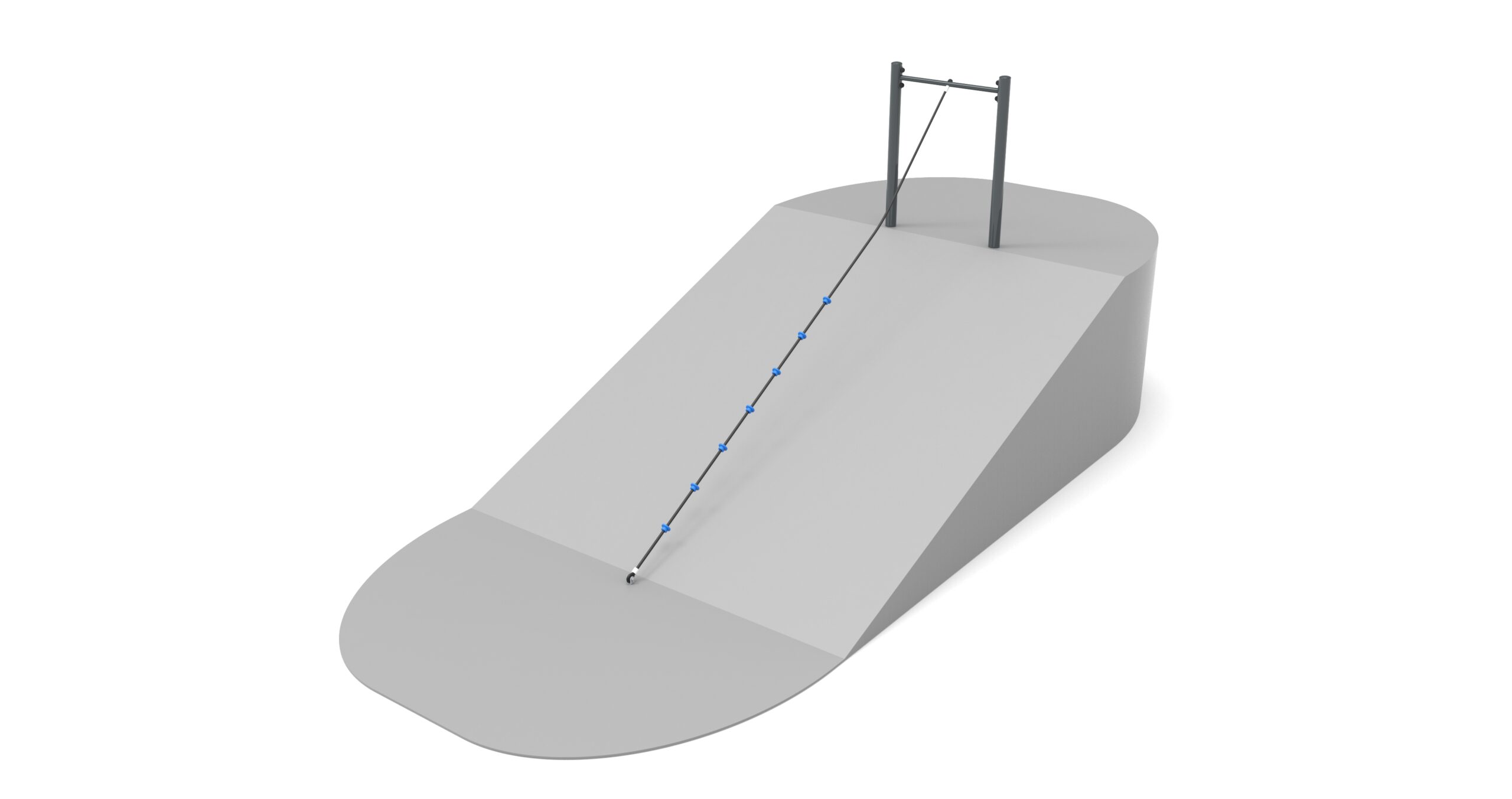
- ropes and nets for scaling the slope,
- climbing walls aligned with the natural incline,
- crawl-through tunnels passing beneath the mound,
- stepping blocks, handholds, and balance features.
FreeKids offers an embankment climbing rope, a climbing wall, an under-hill tunnel, and several models of embankment slides. These solutions can be combined into a cohesive circuit where children climb the slope, conquer various obstacles, and slide back down.
Equipment selection should be guided by the actual terrain profile, target age group, and available space. Not every slope is suited to every slide model. Critical parameters include the vertical height of the hill, slope run length, slope gradient, and the feasibility of delineating the required safety impact areas.
In conventional play structures, a slide typically begins on a platform elevated by posts. To reach it, children use stairs, ladders, or climbing elements. On an embankment, the terrain itself takes over the function of the access platform.
This approach minimizes tall structural elements, but it does not automatically make every layout inherently safer. Designers must still safeguard the launch point, properly grade access paths, select appropriate impact surfacing, and evaluate the critical fall height. Safety is the outcome of a well-engineered total layout, not simply the presence of a natural slope.

Surfacing and Drainage for an Embankment Playground — Key Considerations
On sloping terrain, safety surfacing serves more functions than just shock absorption. It must also maintain stability during rainfalls, prevent soil washouts, and allow children to climb and descend securely. An unsuitable material can migrate downhill or develop ruts in high-traffic zones. The type of surfacing must be matched to the critical fall height of the equipment and the manufacturer’s technical specifications. For public spaces, the requirements of the EN 1176 series (for equipment) and EN 1177 (for impact-attenuating playground surfacing) apply.
Drainage is equally essential. Stormwater running down an incline can pool at the run-out of a slide, erode loose-fill surface material, or expose footings. The design must therefore account for natural runoff directions, soil permeability, and the potential need for French drains or surface interceptors.
Want to learn more about selecting shock-absorbing materials and sub-base preparation? Read our article: Playground surfacing – the foundation of safe and accessible play.
Developing a Sloping Plot in a Park or Residential Estate
In a public park, a natural mound can seamlessly blend the play area into the surrounding landscape. An embankment slide contoured to the hillside is far less visually intrusive than a towering play structure, and climbing elements can be organically integrated among plantings and pedestrian paths.
In residential estates and commercial developments, slopes often result from grade differences between buildings, roads, and green courtyards. Rather than fencing off the embankment or leaving it as a high-maintenance, difficult-to-mow lawn, it can be transformed into an active hub of the communal space.
The master plan should incorporate not only play equipment, but also approach routes, caregiver seating, clear sightlines, and accessibility across different levels. Not every section of the playground needs to sit on an incline. Inclusive equipment, benches, and dedicated areas for toddlers can be situated on the level ground at the base of the slope.
Embankment Playgrounds Tailored to Specific Site Conditions
Off-the-shelf equipment cannot substitute for a topography-conscious layout. Before selecting equipment, one must verify its dimensions, safety clearance zones, fall heights, footing specifications, and surfacing criteria.
By choosing embankment playgrounds from FreeKids, you can combine slides, climbing ropes, crawl tunnels, and climbing walls designed to make the most of both natural and man-made mounds. Individual units can operate as standalone features or form an interconnected activity course.
The best outcome is achieved when the playground layout is designed concurrently with the broader site master plan. This prevents superfluous earthmoving, ensures proper stormwater management, and harnesses elevation changes to create play features that simply cannot be replicated on flat ground.
A sloping site demands a thoughtful approach, yet it offers opportunities that level ground cannot match. Embankment slides, tunnels, and climbing elements create a multi-tiered environment that encourages physical activity, exploration of multiple pathways, and self-directed routing. The key to success lies in tailoring the equipment to real slope parameters, stabilizing the ground, and comprehensively planning surfacing, drainage, and safety zones. Done right, a slope ceases to be a costly challenge—it becomes the defining architectural centerpiece of the entire playground.
Do you have a challenging sloping site to develop?
Instead of investing in expensive earth grading and retaining walls, create a unique multi-level playground that taps into the potential of natural elevation. Our specialists will help you design a safe climbing and sliding course tailored to the specific conditions of your site.